a/eAutoEscapeDEVELOPER GUIDES
HomeGuidesAboutContact
Information
Editorial PolicyPrivacy PolicyTerms of UseCookie PolicyDisclaimer
Menu
HomeGuidesAboutContact

Website information

Editorial PolicyPrivacy PolicyTerms of UseCookie PolicyDisclaimer
Skip to content
  • JavaScript Template Literals Guide
    Guides

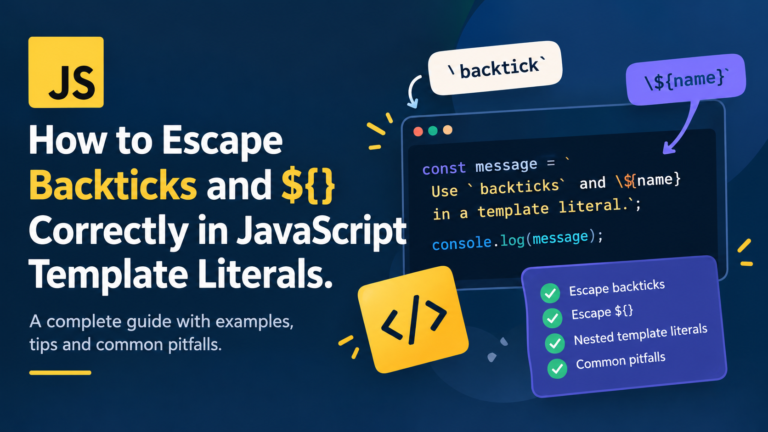
    How to escape backticks and ${} correctly in JavaScript Templat Literals.

    ByAutoEscape October 14, 2026

    Template Literals allow to write multiline strings and insert variables in a string using JavaScript. Unlike string literals made with single and double quotes, template literals use backticks (“`) and you can put expressions inside of ${}. While template literals are useful, when you need to print a literal backtick in the result, or print…
    Read More How to escape backticks and ${} correctly in JavaScript Templat Literals.Continue

  • When to use JSON.stringify() and when to use Manual Escaping?
    Guides

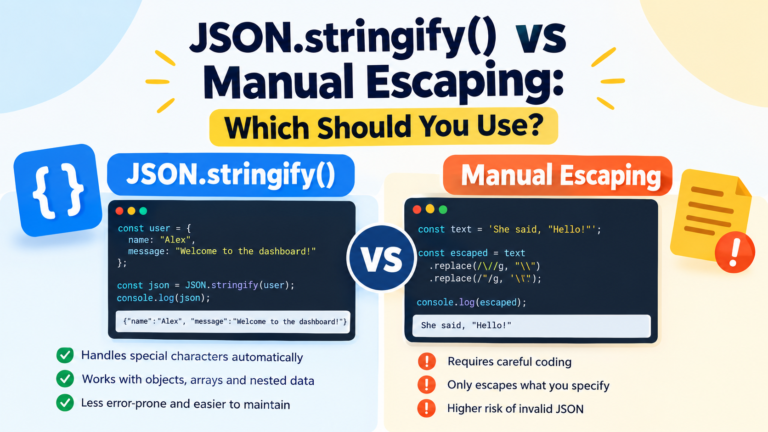
    When to use JSON.stringify() and when to use Manual Escaping?

    ByAutoEscape October 12, 2026

    If you make any error when using JSON in JavaScript, you could end up with a failed API call, a corrupted data string, or an error of invalid JSON. There are two common methods to deal with special characters: escaping characters or using JSON.stringify().Although both have their use cases, using JSON.stringify() is the best way…

    Read More When to use JSON.stringify() and when to use Manual Escaping?Continue

  • Regex Pattern Escaping vs Replacement String Escaping What does it mean
    Guides

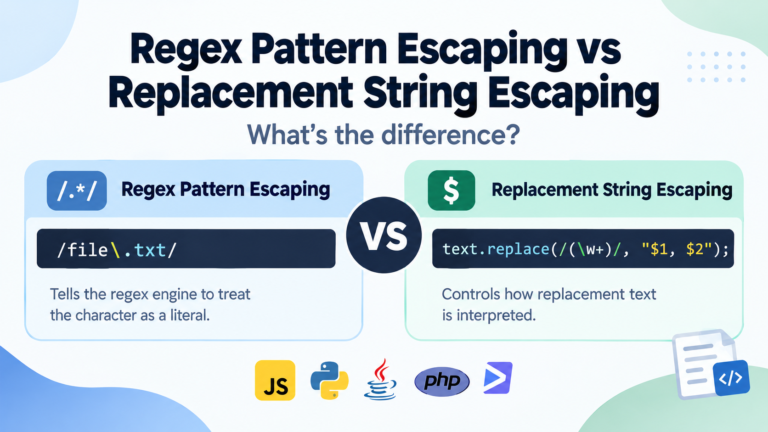
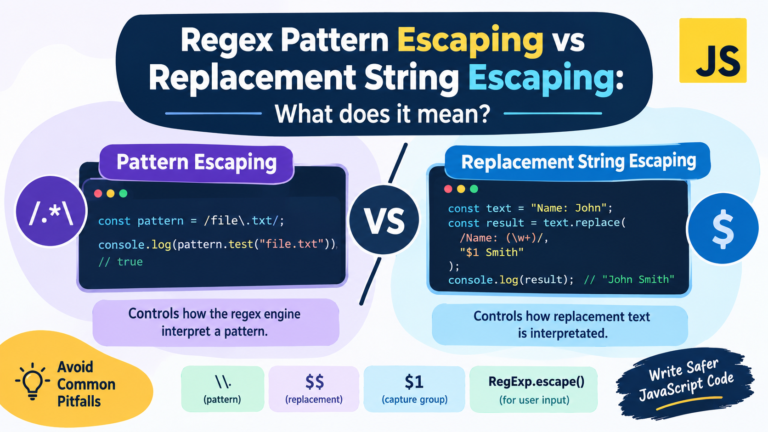
    Regex Pattern Escaping vs Replacement String Escaping: What does it mean?

    ByAutoEscape October 9, 2026

    Regular expressions (regex) is a technique which is used for searching, matching, validating and replacing text in various computer languages including JavaScript, Python, PHP, java etc. However, when one or more special characters approach while searching or replacing, it gets confusing when it comes to using regex. This is one common pitfall, that the way…

    Read More Regex Pattern Escaping vs Replacement String Escaping: What does it mean?Continue

  • How to Match File Paths, URLs, and Literal Symbols with Regex
    Guides

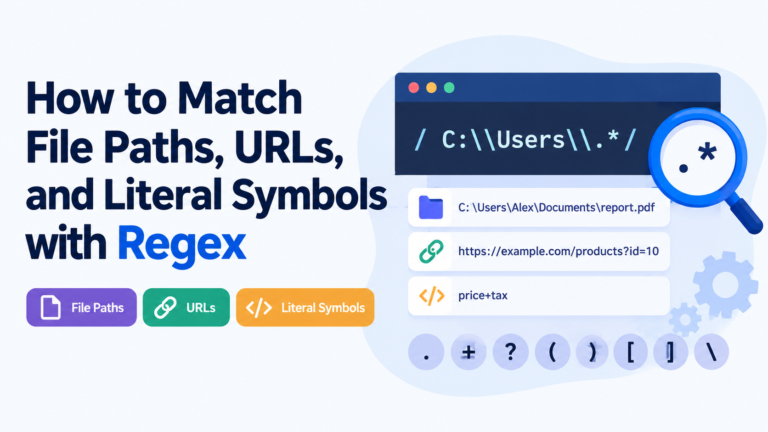
    How to match file path, URL and Literal Symbols with Regex

    ByAutoEscape October 7, 2026

    Comparing file paths, urls and words (or literals) to regular expressions (regex) can be confusing and particularly confusing when special characters are included in the pattern. Some characters like /, +, ., ?, (, ), [, ] and \ have special meanings which will vary by regular expression syntax and by programming language. For instance,…

    Read More How to match file path, URL and Literal Symbols with RegexContinue

  • JavaScript-Regex-Backslash-Guide
    Guides

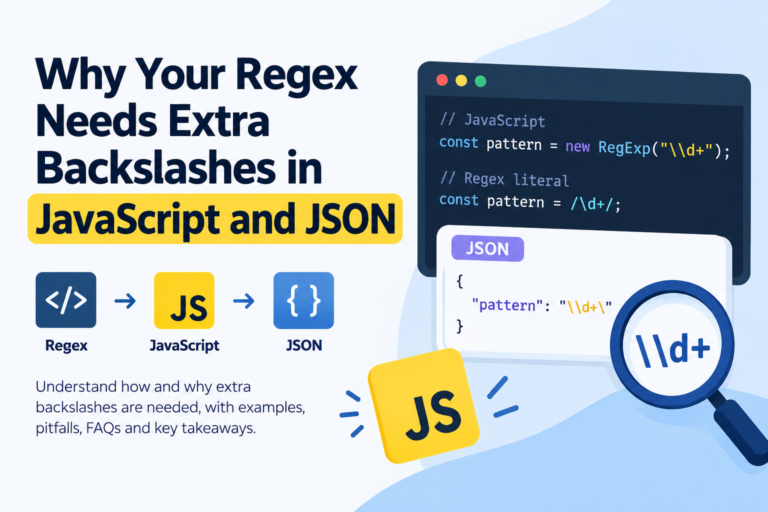
    Understanding why one might need additional backslashes in a regular expression in JavaScript / JSON

    ByAutoEscape October 5, 2026

    The use of regular expressions (regex) for matching, searching, validating, and replacing text has powerful capabilities. In use in JavaScript applications, APIs, in configuration files and JSON based systems. One common problem, however, that developers may encounter is that a regex pattern may require additional backslashes to function properly. For instance you can match a…

    Read More Understanding why one might need additional backslashes in a regular expression in JavaScript / JSONContinue

  • Regex Pattern Escaping vs Replacement String Escaping: What's the difference?
    Guides

    Regex Pattern Escaping vs Replacement String Escaping: What’s the difference?

    ByAutoEscape October 3, 2026

    Regular expressions, (regex) are brilliant patterns for searching, matching, validating and replacing text data in programming languages including JavaScript, Python, PHP and Java. But it’s possible to get special characters confused, particularly in the case of special character escaping in a pattern and a replacement. A common pitfall that developers tend to get is mixing…

    Read More Regex Pattern Escaping vs Replacement String Escaping: What’s the difference?Continue

Page navigation

Previous PagePrevious 1 2 3 4 5 6 Next PageNext

Small details.
Clean results.

Practical developer guides on JSON, HTML, URLs, regex and Markdown. Clear explanations for the details that matter.

Explore Guides ↗

Explore

  • Home
  • Guides
  • About
  • Editorial Policy

Policies

  • Privacy Policy
  • Terms of Use
  • Cookie Policy
  • Disclaimer

Get in touch

  • Contact
  • support@autoescape.online

Operated by Noah
United Kingdom

© 2026 AutoEscape. Developer guides.

Privacy settings
Scroll to top